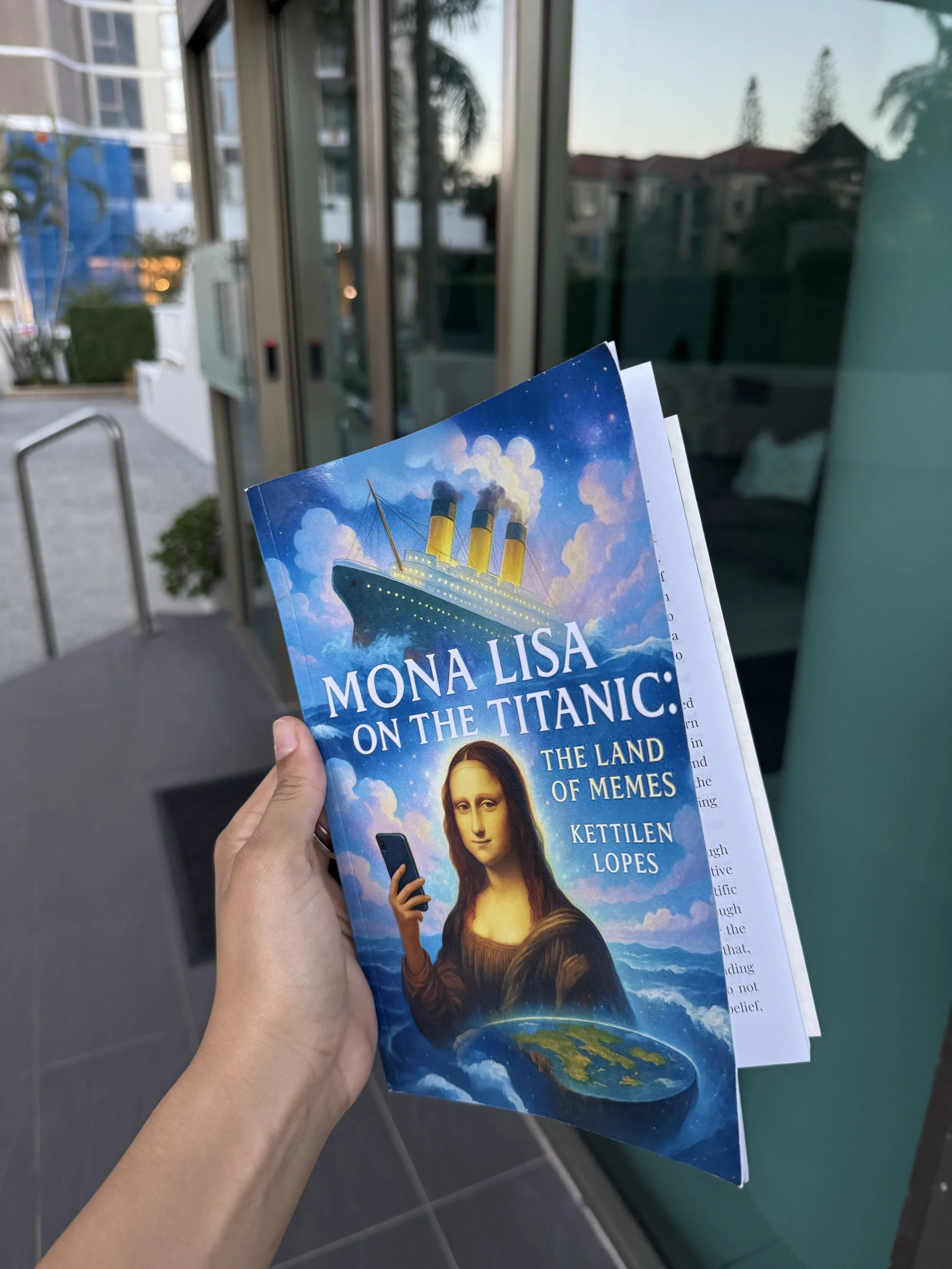
Mona Lisa on Titanic: The Land of Memes
Do we laugh, or cry? Where is our little boat heading? Each with their own opinion... the cordiality of the Brazilian people?
Sit down, let's talk. I'll take a little of your time, but who knows, it might be worth a lot in the end, maybe it will give much more time to someone you may not even know yet. Giving: what a beautiful thing, isn't it?
Have you ever wondered at any moment what life is? It's interesting, I guarantee. Life is so interesting that, perhaps, the most interesting thing is precisely not knowing.
How little we know. We know little about others, little about ourselves. Know nothing about the world. We are conditioned to see only what is immediate to us.
How difficult it is to see a reality that does not belong to us. How difficult it is to put ourselves in someone else's shoes. Many times, it's not even convenient.
Have you ever imagined yourself in the place of that person sleeping on the street, whom we pass by and pretend not to see? No. You would never be like that.
You would look for a job, you would try to study, you would try to be human... Are these people human? I don't know. But you would never come close to being in that situation: in some way, you consider yourself different.
And can I blame you? Of course not. You were taught to think that way. If you grew up hearing that if others don't have the same opportunities as you, "it's because they didn't work enough," "didn't study enough," "didn't try hard enough," how could I demand that you look differently at these people?
If we grew up thinking that the structures around us were given; that things are the way they are simply because they are - they always have been and always will be that way - what can I try to show you? In a way, you're right.
Yes, you're right. Do you realize how small we are? Do you realize how limited our actions are to our immediate surroundings?
Do you realize that, alone, I can't do much? I can't change much. Do you know that food we occasionally donate? Well, it's beautiful, isn't it? I admire... how kind we are! But you know what happens? Those same people will need to eat the next day, the next, the next...
So, there you can agree with me: we can't always take from ourselves to provide for others. We have our commitments, our jobs. We made an effort to have what we have. Probably only you know what you've been through to be where you are; to be here reading this book.
So, my story doesn't reach that point. In fact, at one point - still at 17 - I planned with my prep course teacher to spend one or two days in the condition of those people living on the streets. We wanted to feel in our own skin what it was like to live like that, but it didn't work out. It hasn't worked out yet, maybe someday...
But no! I don't want anything like that from you. Don't think that this is an encouragement for you to do any crazy stuff.
Here, I just ask for a few moments of your thought. I just ask for your willingness to step out of your own pain for a moment and allow yourself to be in someone else's shoes. Simply through your imagination.
This is my story, it's my life, it's me. I write this at 19, and wow! So much has happened. Maybe by delving into my journey and my thoughts, you might be able to understand me, understand what I believe in, and what I defend. Understand what, through this narrative, I'm trying to show you.
I want to use my story here to provoke you to think about your positions, not to change you. Changing you wouldn't be possible; it would be too pretentious. Only you can change yourself.
What I want here is for you to just think better, be open to discovering worlds beyond yours, and perhaps find answers to some of the questions above.
Chapter 1
Stories and Flashes of Memories
I was born in the city of Goiânia, the capital of Goiás. At that moment in my life, it's not surprising that I don't remember much. Some childhood stories remain from the few stories I've heard, and in the case of my birth, my registration. My mother was 16 when I was born, and my father was around 24. It was that typical marriage where the young girl joins the boy to take care of the family while he, the husband, brings home the food. More than that, I was the result of a cliché and historical "marriage" in which the white farmer impregnates a black girl coming from extreme poverty. There was no document, there wasn't even a marriage; there were just two people who got together. And guess what? The girl left the city for a farm in the countryside, where she now had to take care of her husband and their little daughter because now she was a family woman. So, I grew up in a small town called Edéia, with moments alternating between the farm and the city, as you'll see shortly. I was a very chubby girl; I mention this curiosity just because of the strangeness of so much thinness in the future. There was a photo of my dear grandfather holding me near a horse, a photo that, by the way, I would very much like to recover.
The few memories I still have of that place are of a stream that ran through the middle of the road leading to the farm. Near it, there was a coconut tree, and among my memories that often I can't even distinguish if it was a dream, I remember my mother taking me to that place that I confidently called "my little stream". Of course, with my baby bottle by my side. I already owned everything, but the milk was the best; I wouldn't let it go. I still vaguely remember a time when the cart overturned with my mother near the gate – I have to make a great effort to find out what happened, but I know that, for me, it was absurd for that to happen: "Wait, little horse, my Mooom."
In Aunt Maria's house, on a neighboring farm, there were various remnants of those moments: the crib, a photo of that spoiled little girl wanting her mother... (imagine a wide-open crying mouth when someone bothered me). The funny thing is, I don't remember much of these things, but the best part is that, as I write, some memories return to my mind. For me, everything was normal. There was also a macaw named Rosa, from my great-grandmother Geralda, which was awesome. There were many things that, even if I still remembered, wouldn't fit here. What matters, however, is that I was a child, and in that role, I was incapable of imagining the full context around me. I vaguely remembered things that marked me, like my little stream, the cart, the horse photo, my aunt's crib, my great-grandmother's macaw... but I never imagined what was happening behind the scenes, what my mother had to endure to be there.
The interesting thing is that each character has their story, and this is another inevitability that we often don't realize in life. How interesting the person you have next to you can be; the one you cross paths with at the corner; the one you least expect. And so it was. Each person there had their own story, had gone through things that made them who they were and had to accept what they had to accept. And so was my mother's story, a crucial story, perhaps the main one in this book.
In another memory of my childhood, almost one of the only ones with my mother, I remember us already in the city, it was an afternoon when my father arrived. Then, in the room near an old wardrobe that existed until recently, my mother asked something like if he was cheating on her. And his response? A slap on her face. Heavy, isn't it? Sadly, one of the clearest memories of your mother is a slap in the face from your father. However, that was not the worst reality. A little older, when I went on vacation to my grandmother's house, she told me many things about my mother. One day, when I accompanied her to the house of one of her employers, where she worked as a cleaner, she started telling me stories while doing her job. It wasn't the first time my father had assaulted my mother, certainly not the last, and certainly not the worst thing he had ever done. My grandmother told me stories like one day when he made her sleep outside the house on the farm, alone with me in the cold, exposed to any danger. Still, her only concern was to protect me. I was a baby, I was a child, and even if I saw everything, I wouldn't have the capacity to understand, let alone remember everything that maybe I saw her go through.
In a context told by another person, I learned that my mother was already in the eighth month of pregnancy with a younger brother I would have. The thing is, she complained of feeling a lot of pain, and deep cramps while crying and lamenting so much. My father, meanwhile, said it was just a fuss. I don't remember what event led this person to take her, even without my father's permission, to the hospital. By the time they arrived, it was too late; the baby was dead for over a day. I can't imagine the pain she went through again. More than the husband's indifference and everything she had to endure, she had lost a child, a life that she was so eager to generate with so much love. My father, who said that for those who died, it was enough to bury them, seeing the little coffin of his son, locked himself in the room without stopping crying. I was very small; I still didn't understand what was happening.
How can I not say that this was the worst? I'm afraid of not giving it the importance it deserves; after all, we had just lost our first life there. However, I hope you understand what I mean; the hardest, the cruelest, the saddest story that would happen to me regarding the rest, is that my mother had just discovered she had cancer. I also imagine that, in her pains, there was nothing of a fuss. Before turning 20, she had cancer. I repeat: I was a child, how could I know what that was? I didn't know. At that time, I wasn't even four years yet.
Introduction